Poison in Plain Sight: What We Normalise Despite What We Know
Hi everyone,
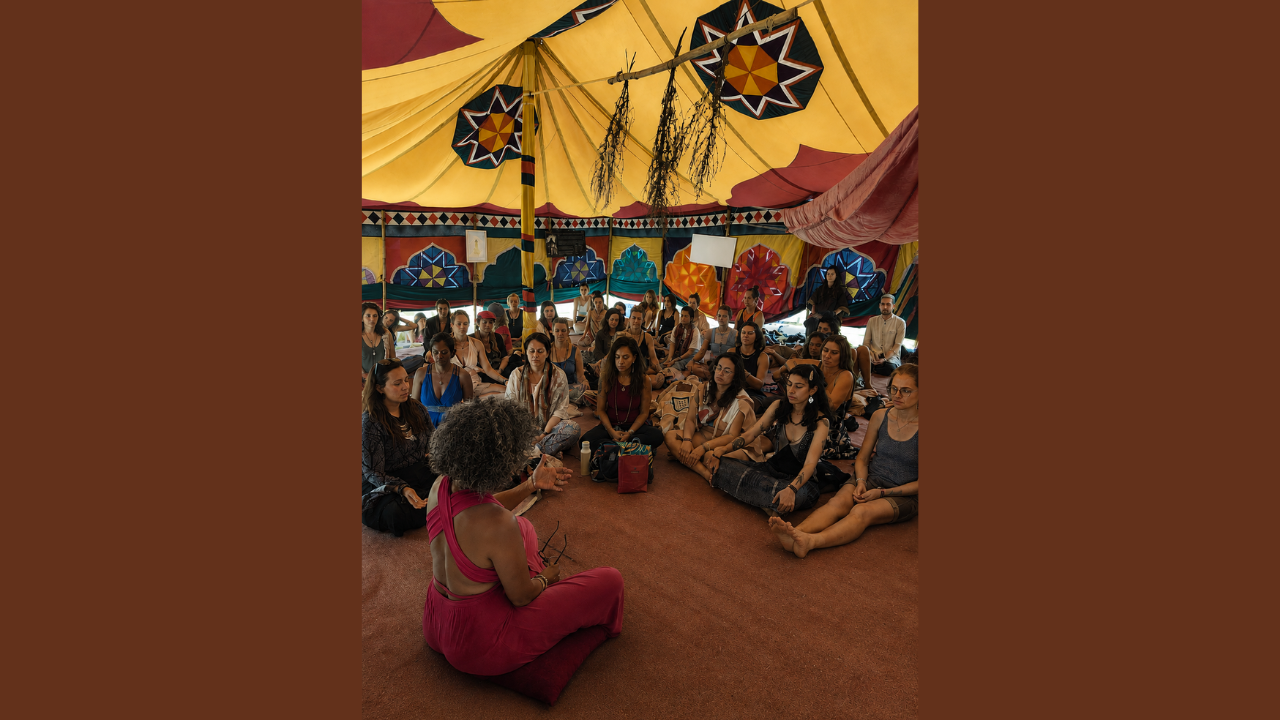
So that’s me underneath all that protective gear, and that’s me in the group photo above too, 24 hours beforehand. I’m nestled in amongst a group of 45 engaged and inspiring leaders from different countries and multiple sectors, all gathering at the stunning Broughton Hall Sanctuary in Yorkshire.
I’d been invited by my dear friend Nikki Trott to facilitate some sessions on her inaugural retreat, based on her wonderful new book, Sacred Business…(We’ll be hosting a women’s retreat together soon, more below.)
The terms sacred and business are not ones we are used to placing together in our modern lexicon. And yet, for me this inquiry really is in my wheelhouse, because it examines business as a sacred act or expression.
Hold that thought.
At the Isumataq Collective, we explore the issues, complexities and extraordinary gifts that sit right in the intersection of business, spirituality, leadership, and womanhood, so I’m a captive audience.
Also, I can’t lie, 4 days away from family at Broughton Hall Sanctuary, a place that feels deeply nourishing, where care is felt in every detail of the food, house and land, was a delicious bonus.
What felt deeply inspiring was that this group of 45 leaders from different countries and sectors, fashion, finance, impact investing, regenerative farming, wellness, media, real estate and travel, who showed up for four days, were brave and willing to truly explore this concept and interrogate what and how this might be possible for their business models, organisations, people and culture.
All of it at a time when the world around us feels like it is burning.
When systems continue to self destruct, to implode under their own weight, where trust is of course eroding. Not because people don’t want to believe, but because they can feel when something is really off, something is not quite true.
There is something in the collective field that is no longer willing to be convinced by metrics alone. We are seeing, and can no longer deny, the limits of a system built primarily on principles of extraction, optimisation, profit and performance.
So you can imagine how marvellous it was to feel something else, something hopeful happening in parallel, in real time amongst us.
There were so many insights that emerged from our four days together that I can’t capture them all here now, but they will no doubt inspire future letters.
However, a few things really struck me as topics that I felt duty bound not to shy away from. One was a discussion that surfaced our inability to presence love as a central pillar of what we do in business.
I know, it’s uncomfortable isn’t it?
It’s okay to talk about purpose.
It’s okay to talk about vision.
It’s even okay to talk about values, impact, or culture.
But when we strip it right back to essence, and remove all proxies for love, it feels profound to explore why it is still not okay to talk about love in a business sense.
What’s the worry? Would it soften our capacity to function in highly competitive markets, where domination and power-over still shape our business culture with outdated, almost colonial ideals that promote inequality and incentivise us to pursue profit over people?
Or might it give our products and services greater soul and more resonance? Might it help us interrogate the quality and necessity of what we offer?
God knows how much the human condition yearns for this elephant in the boardroom, and how such a deep anchor might inform the principles and values we claim to stand for.
At a point over the weekend, I found myself discussing my own career as a young woman growing up in investment banking. Who I was then, and what I am awakening to now, ongoing of course.
Had I, and indeed so many others like me, become so far removed from what I might call the feminine… that as women, we have become overly shaped by masculine ideals, by boardroom politics, metrics, goals, ROIs, profit and loss? Trapped in systems that were not designed by us or for us?
I felt sad and confused to hear from a professional who had worked for years in the charitable sector, utterly devoted to impact and change, but who over time had become despondent and demotivated. When it came to naming love, or indeed language that might relate to such an ideal and shape a charity’s intentions for good, it was shunned.
Because it couldn’t be measured.
Because it wasn’t goal oriented enough.
Because where were the KPIs.
And of course, yes, there’s an argument that certain language fits certain contexts. But there is also a deeper truth emerging.
We have become so disconnected from the very principles that animate our purpose that we’ve made them wrong. Unacceptable. Unprofessional.
And perhaps this is exactly what we are being asked to interrogate more deeply.
To question not just what we build, but what we allow to belong.
Because whether we call it compassionate leadership, human centred leadership, heart led leadership, soul led business, regenerative business, conscious capitalism and so on, we are, in many ways I feel, dancing around the same thing.
We are dancing around love, and trying to create palatable and acceptable conditions within which to express it.
Yet what I witnessed in these four days was concentric circles of communities, small circular pods of people that would gravitate towards each other, yearning to overlap. Warming as they draw closer, connected by this immense invisible force for good, what I can only describe as love.
A different architecture emerging, one built on deeper connection rather than extraction.
For four days, I had been inside something that felt like a different way of doing business.
And then came the contrast.
Monday evening, I arrived home full of hope and possibility.
By Tuesday morning, I was lying in my dentist’s chair for two and a half hours, having the last of my mercury fillings removed.
Now if you’ve ever had this removal done holistically, you’ll know it’s no small thing. Full body protection is recommended. Face covered. Pink mouth guard attached, gas mask and breathing apparatus on due to the poisonous gaseous nature of the mercury released on removal.
But as I lay there, I found myself in deep contemplation about this extraordinary, malleable yet poisonous metal, extracted from the earth and now sitting in my mouth.
How could an entire industry, and I am not pointing the finger at any one practitioner, but how could an entire system have normalised something so fundamentally toxic to the human body?
Because here is what we knew in the 18th and 19th centuries. Hat makers, called hatters, used a chemical process to turn animal fur, often rabbit or beaver, into felt. This process involved mercury nitrate.
Over time, hatters were exposed to mercury vapors, which are highly toxic, and this led to a condition known as mercurial erethism, or Mad Hatter syndrome, resulting in symptoms like memory loss, tremors, mood swings and irritability.
And here is what we know now…
That for decades, dental amalgam, made up of roughly 50 percent mercury, a known neurotoxin, was widely used across the world.
Before 2018 it was standard practice. In 2018 its use was banned across the EU for children under 15, pregnant women and breastfeeding women.
And now
As of January 1 2025 the EU has enacted a near total phase out of dental amalgam for all patients, with only rare medical exceptions. And by July 1 2026 manufacture, export and import will also be prohibited, effectively ending its lifecycle within the EU.
Even before this, countries like Norway and Sweden had already moved ahead with earlier bans, and globally around 43 countries have now banned or severely restricted amalgam under the Minamata Convention.
So as I lay with my jaw stretched to capacity, two anesthetics later, my question lingered.
How did something like this become standard?
How did something potentially harmful become normalised under the banner of best practice, only to then be systematically phased out?
Alongside my profound gratitude to my holistic dentist, a wider reflection began to emerge. This was not just about dentistry. This is about business, systems, and what gets legitimised. About what we collectively agree is acceptable, even when it quietly contradicts deeper truths.
On one hand I’d just come from a space where love exists, but struggles to be named in business because it cannot be measured by the prevailing logic.
On the other, I’ve entered a system where toxicity was normalised because it could be operationalised.
Measured.
Scaled.
Standardised.
So perhaps the inquiry is this.
What have we made invisible because it cannot be quantified? And what have we allowed because it can?
What have we exiled in the name of professionalism?
And what have we permitted in the name of progress?
Because if we are truly speaking about sacredness in business, or conscious business, human centred leadership, heart led leadership, soul led business, regenerative business, conscious capitalism and so on, any set of principles that enable us to shift the ways in which we conduct ourselves and business, then perhaps it’s about creating the conditions where love is not an afterthought, but a foundational principle of how we wish to operate.
At the very least, acknowledged at its source, whether it is expressed as purpose, vision or something else entirely.
Where we no longer defer to powers that keep us disempowered.
Where we are no longer numbed to harm simply because it has been normalised.
And perhaps this is the real work.
Not just to build new systems
but to re-sensitise ourselves to what is true and needed.
To what is life giving.
To what belongs.
Because the future may not be built by those who optimise best
but by those who are willing to feel deeply enough
to choose differently.
Perhaps the world is not just burning, but revealing the limits of what we have built without love.
Remi
PS if you got this far, Nikki and I will be joining forces to run a women’s retreat. If you feel drawn, you can express your interest here.
Isumataq Collective teams up with Sacred Business to offer an immersive two day exploration of soulful, relational ways of being in business as women, and the systems we are here to reshape and reimagine.
PPS - If you are enjoying these newsletters and want to support the growth of this community, please forward and share them!